Recording is the easy part.
Anyone can film a task. The value is in everything that happens between raw footage and data a model can actually learn from, and almost no one does that part well.
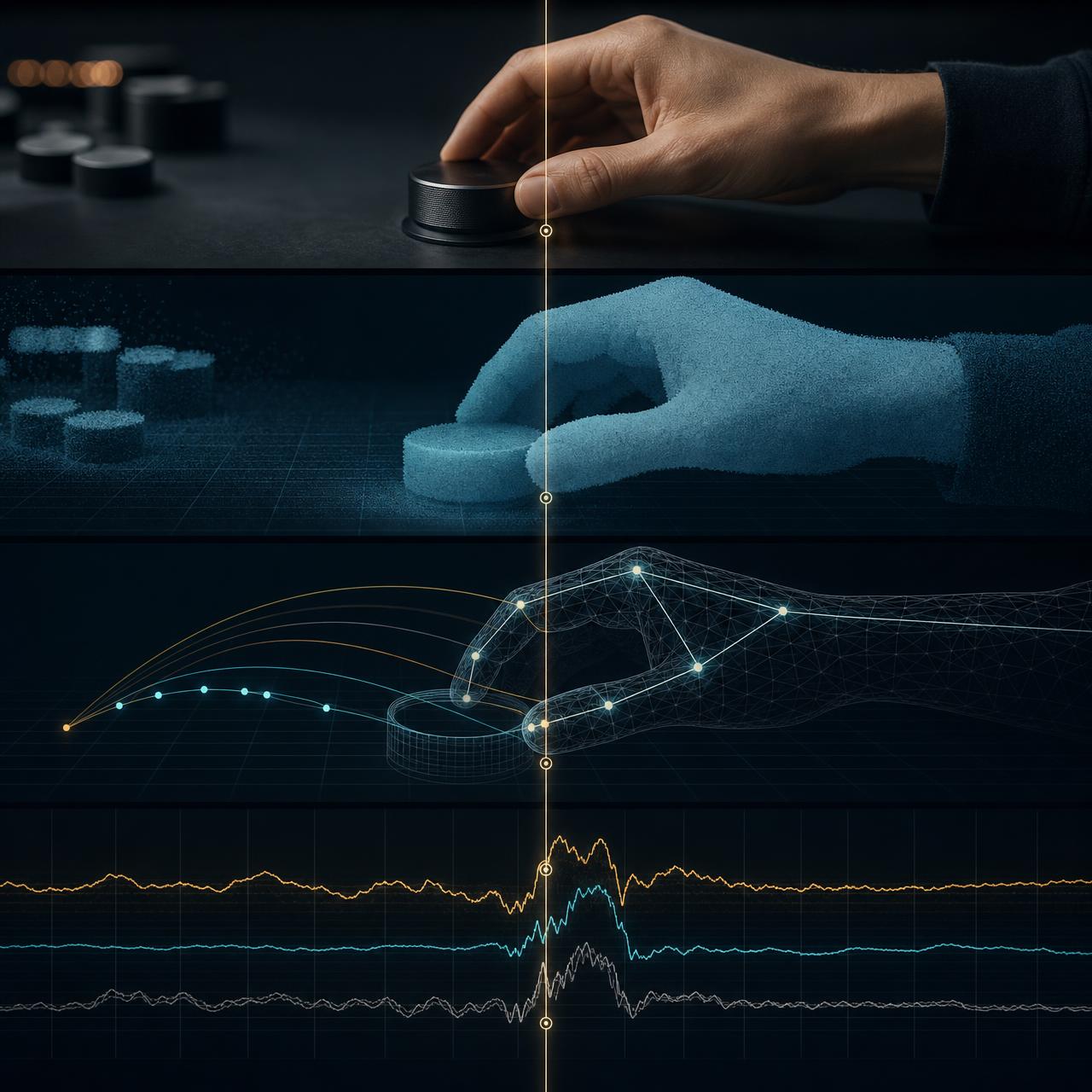
A capture is never a single video. It is several streams recorded at once: the camera, depth, motion, force and torque at the wrist, the pressure across a glove. Each runs at its own rate and begins at its own moment. For a model to learn from the result, every one of those streams has to be aligned so that at any instant the image, the hand position, the contact force and the depth all describe the same moment in time. Misalign them by a fraction and the model learns that contact occurred at the wrong frame. The footage looks fine and misalignment can corrupt the learning signal.
This is why collection is the cheap part and where most competition sits. Filming a person doing a task requires a camera and a willing pair of hands. Turning that into training data requires something far harder: temporal synchronisation across modalities, calibration held across sessions, segmentation of a continuous performance into the atomic actions a model reasons over, labelling of grasps, contacts, and the moments where a task fails and recovers, and consistency in all of it across thousands of hours and dozens of environments. Collecting multimodal data is hard. Making it meaningful is harder.
The gap shows up as a quiet tax on every model team that buys raw footage. Data arrives as undifferentiated video and has to be cleaned, aligned, and annotated in-house before a single training run can use it, and the annotation that matters most — motion quality, grasp accuracy, failure characterisation — demands judgement that generic labelling cannot supply. A supplier that delivers volume and stops at the recording has handed the customer the hardest and least scalable part of the problem, dressed as a finished product.
It is also where commodity collection and real infrastructure separate. Price per hour is one axis. Producing synchronised, richly annotated, consistently labelled data at scale across many sites is another, and it is an operational discipline rather than a headcount. The barrier is not the camera. It is the pipeline behind it: calibrated capture, time alignment at the source, sensor-integrity checks, annotation built for robotics rather than borrowed from image tagging, and quality control that holds the same standard from the first batch to the ten-thousandth.
This is the layer Physicore is built around, and it is why the relationship with a lab runs deeper than supply. The annotation schema is defined against how a specific model represents actions and contacts, so labels arrive in the form the training code expects rather than a form that has to be rebuilt. Synchronisation and quality thresholds are set to the fidelity the task requires. The output is not a hard drive of footage but a dataset that enters the pipeline and trains, with provenance and structure intact. The capture is the scale. This is the edge.
Recording was never the hard part, and treating it as the product is how a data strategy quietly fails. The work that decides whether footage becomes intelligence is everything that happens after the camera stops, and doing that work to a standard a frontier model can rely on is the difference between a supplier and the infrastructure a programme is built on.
— Sources & technical references
— Further reading