The teleoperation ceiling.
Teleoperation is the gold standard for robot data and the hardest to scale. Resolving that tension, rather than ignoring it, is where the real value sits.
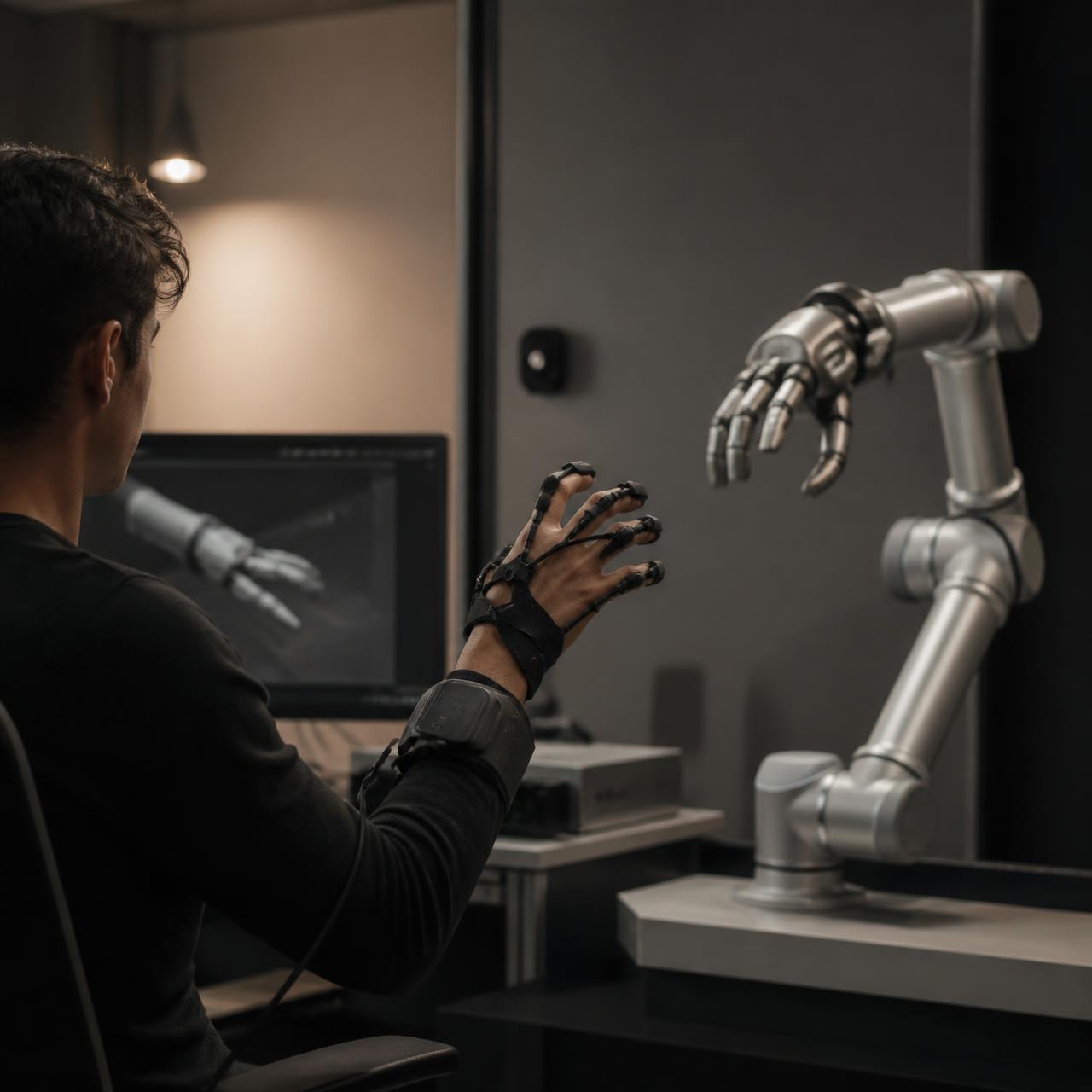
Teleoperation produces the most valuable data in physical AI. A human directly controlling a robot generates exactly what a deployed model needs: real motor commands, true force and contact profiles, and task execution in the robot's own body rather than a human's. It is the closest data gets to the thing the model will actually do. It is also structurally expensive to produce, requiring a full robot rig and a trained operator for every hour collected.
That tension defines the economics of robot learning. Teleoperation is too valuable to abandon and too expensive to lean on. Leading labs are explicit that they aim to reduce teleoperation's share of the training mix without losing what only teleoperation provides. The question is not whether to collect it. It is how to get the irreplaceable signal it carries while collecting far less of it.
The answer the field has converged on is a division of labour across the data pyramid. Broad, first-person human data carries the load of coverage, teaching a model the wide range of how tasks unfold across objects and environments at a fraction of the cost. Teleoperation is then reserved for what only it can give — the exact execution, the contact dynamics, the robot-native motor traces — applied precisely where a model's performance depends on them. Used this way, teleoperation stops being a volume problem and becomes a precision instrument, expensive by the hour but deployed only where its value is highest. Expensive robot-native data should be concentrated where evaluation shows it adds information cheaper sources cannot.
Getting that balance right is an operational discipline, not a slogan, and it is where most data strategies quietly fail. Collect too little teleoperation and a model never learns reliable execution; collect too much and the cost of the programme outruns its value. The right ratio is not fixed. It shifts by task, by embodiment, and by where a model is currently weak, which means it has to be set against a specific model's needs rather than guessed at in the abstract.
This is where the work with a lab becomes concrete. A programme is structured so the cheap, broad layer does the heavy lifting of coverage, and teleoperation is directed only at the tasks and contact regimes where the model genuinely requires robot-native data, on the embodiment it actually runs. The mix is tuned over successive rounds against where performance is moving, so the expensive hours are spent where they change the model and nowhere else. The output spans the full pyramid, assembled deliberately rather than skewed toward whichever layer was easiest to gather.
The teleoperation ceiling is real, and it does not lift by collecting more of the most expensive data. It lifts by knowing exactly where that data is irreplaceable and capturing everything else in the forms that scale. Holding that line, the gold standard where it counts and breadth everywhere else, is what separates a programme that can afford to reach reliability from one that runs out of money before it gets there.
— Further reading